New ADAGE Youth Development Program is the present name of a school-based grass-root
Anti-Drug and Anti-Gang Alternative Program created in 1986 by Ed Cabil, a school counselor at John Muir Junior High School.
The original program grew out of a need to build the self-esteem of youths living in South Central Los Angeles, and at the same time establish a peaceful coexistence between the police officers of the 77th Division and the teens and young adults living in the John Muir Junior High School community. Tension had been running high following the arrest of a fourteen year old for shooting and killing a police officer. For many years, the Black community held ill feelings toward the police for alleged police brutality and the shooting deaths of its Black youths.
As the first Drug Intervention (LAUSD IMPACT) Coordinator assigned to Muir, I observed a very disturbing scene. A 13 year old was pointing his index finger as if it were the barrel of a handgun at the head of the newly assigned DARE Officer as he was walking across the yard to his designated class. What made this incident so disturbing was the fact that this was the fifth time in one day – each time a different youth was involved.
Notwithstanding the fact that both the school district and the police department joined forces to combat the ever-growing drug problem in L.A. schools through the DARE Officer in the classroom for drug education and the LAUSD Impact (Drug Intervention) Program, something was still missing. Immediately following dismissal from school, pupils were involved in fights, assaults, and robberies on their way home from school daily. Much of this negative activity was the acts of gang members. Most often, these were the kids who were systematically shut out of the system through rigid requirements and guidelines. They did not have the required “C” averages, nor did they have the necessary attendance or behavior record to join traditional school-sponsored clubs.
Moreover, this was the beginning of a new phenomenon called “PUT ON” (today, still unknown to the general public and even most parents) where kids were beaten and assaulted each day until they submitted to joining the ruling gang in their neighborhood. Please know that in each case, it is always against a child’s will to succumb to such acts.
Remembering prior to the passage of Proposition 13, Ed Cabil and other coaches kept nearly all of the young males after school busy in active seasonal sport participation. This was the missing element that the school district and the police department failed to realize.
There were a number of obstacles and constraints to consider to re-institute the after school sports program; first, one would have to constantly face and stand against gang members seeking to “put on” new members; two, the possibility of gang fights could occur at anytime without warning; and three, there would be no funding.
Ed Cabil went on a commitment of dedication and faith to save the kids and the community from continuing self-destruction. One day, all alone, Ed Cabil brought all the kids in the auditorium and asked what types of activities did they want – and the rest is history. Six years later, a model program has emerged with components for total gang and drug elimination.
Utilizing a successful concept incorporated to build pride in keeping the campus clean in the early 70’s, “Self-Pride Generates School-Pride,” Ed Cabil used the very same elements to reach the hearts and minds of his youths: To meet their basic human needs – “To Love and Be Loved,” and “To Feel Worthwhile To Themselves and To Others!”
The key to breaking down anti-police feelings was a long process which resulted in the first basketball team members wearing a newly created uniform displaying the first DARE Police Division logo centered in the LAPD officers’ badge.
This long process included an offer so good for the police that they simply could not say no. The kids were told that there would be a strong possibility of being funded for uniforms, supplies and equipment for other sport activities. I submitted a proposal to DARE and received financial assistance for the programs as was promised to the kids.
Carefully designed steps were taken to ease the tension between the police and the youths. An effective tool was a well-coordinated effort (through my community resources) to compete against the police in basketball. After the best of a three-games series, the officers could bring their family members to watch the games. For the first time, our kids got to see police officers as human beings – people, who just like themselves had families and values, but had a different and difficult public service job to perform.
The girls (who were not forgotten) wanted a drill team, one where (grades and past behavior records) restrictions would not be a problem. Along with donations from private parties and local businesses in the area – plus a $2,200 contribution from Ed Cabil, 105 girls outfitted, making this New ADGAE drill team the largest ever in history.
In addition to the basketball team and the drill team, there were three football teams and a soccer team. The above activities comprised our first intramural program.
It was discovered that competition was the key for maintaining students’ interest in sports competition. Although LAUSD offered competition between schools on a one time annual basis for seasonal sports, drill teams, and cheerleaders, the kids wanted full time competition – just like the high schools.
In 1988, after playing our archrival Horace Mann several times with a culmination basketball game at the Sports Arena, Ed Cabil submitted a proposal to Captain Bostic, then DARE Division head, for more funding to support a growing model school concept of anti-drug and anti-gang success. One year later, Nancy Reagan came to John Muir Junior High School and brought $50,000 that was matched onstage by Nathan Shapell. A year and a half later, DARE America donated $50,000.
In 1989, the After School Alternative Program of John Muir Junior High School was unprecedented in breaking the cycle of gang involvement and drug use on campus. This was accomplished by using the Nancy Reagan money to hire coaches and instructors with the highest level of expertise in music, sports, drill team, etc.
With the combination of expert coaching and proper leadership, the students found it safer to remain after school rather than walk home immediately after the ringing of the bell. This was because of strong supervision and constant guidance techniques to offset advancements made by gangs to recruit potential members on our campus.
Another key factor was the fact that many of the coaches drove their high-risk students home for years (until after graduation) so that their safety was ensured. The term “BALLER” (sport star) was used to ward off confrontations by gang members. The term soon became popular all over, and thus, all the kids in sports and other activities used it for their safety.
In 1989-90, both our intramural and interscholastic programs extended to the limits. Eleven schools joined the After School Alternative Program Interscholastic Basketball, Softball and Track & Field leagues. In 190-91, three additional teams joined, and in 1991-92, we had a total of seventeen teams to join the league. In 1992, New ADAGE incorporated so that it could receive funds from the Amateur Athletic Foundation.
In addition to seventeen schools in our sports league, our total programs consist of seventeen clubs: Mock Trial Team, Modeling & Charm, Drill Team, Cheerleading, Drama, Dance, Chorus, Key Boarding, Drum Corp, Clown Club, Robotic Club, and soon to be Play Station 2 Sports.
We were proud that New ADAGE had been partnered with the Los Angeles Unified School District since 1986, for in-kind services (exclusive full use of school facilities and playing fields), the Amateur Athletic Foundation funding since 1993, and L.A. Bridges, a City of L.A. Anti-Gang Program for five years; however, at the brink of initiating a plan to strengthen the New ADAGE infrastructure and adding newly-trained board members, LAUSD, under the new leadership of Superintendent Roy Romer, denied the New ADAGE Youth Development Program the right to use LAUSD facilities, thus, the Model Anti-Drug, Anti-Gang Program for the Nation was shut down due to having no facilities which resulted in a cut of funding from private sources.
Until being closed by LAUSD in 2001 (operating on a minimum budget) the New ADAGE Program had maintained its enrollment of seventeen schools with an additional three schools from other parts of the city. Incidentally, these twenty middle schools had a total enrollment of over 40,000 students. Undoubtedly, with sufficient funding, we would have included all of the districts’ remaining thirty-one middle schools. It was our primary goal to provide the John Muir model in each of the thirteen zip codes comprising the CIPA 2 (Community Improvement Planning Areas – high drug/crime, low poverty areas
of L.A.) 90002, 90003, 90007, 90008, 9001, 90016, 90018, 90043, 90044, 90047, 90059, 90061, and 90062.
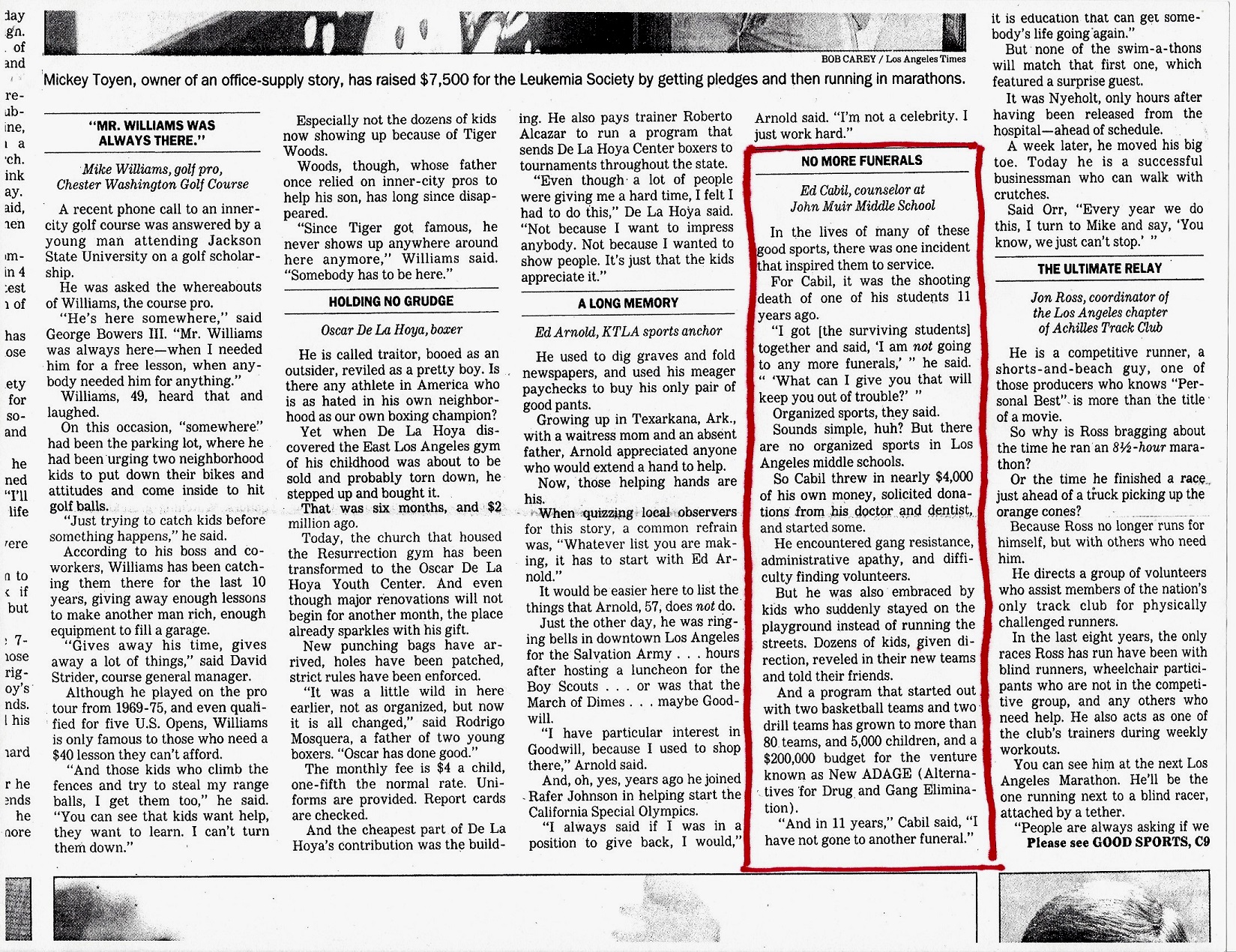
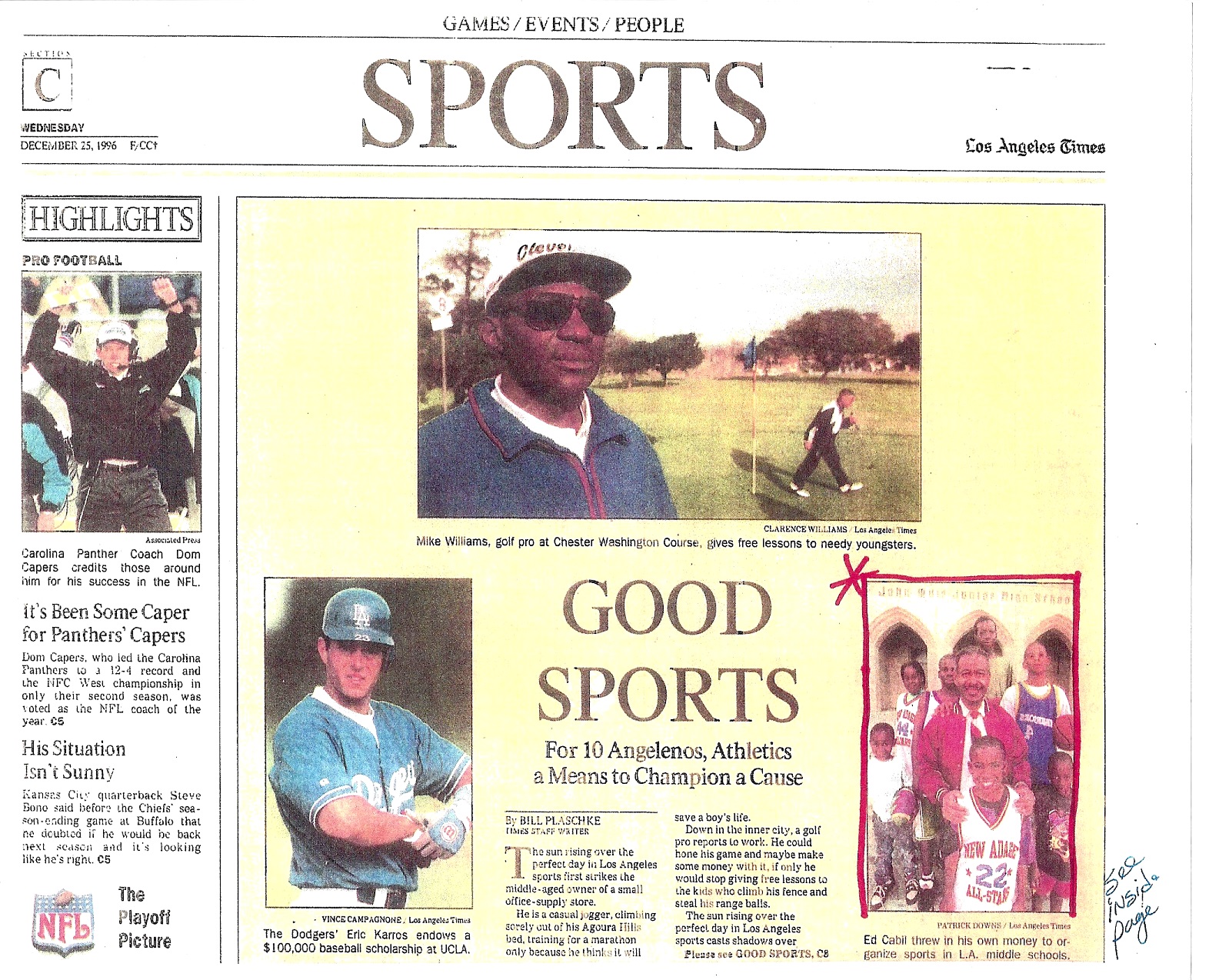
Looking back over the sixteen consecutive years of service to South Central Los Angeles, we were proud to learn of former New ADAGE student participants who went on the great accomplishments. We know of Arthur Lee, the Stanford star basketball player (a John Muir graduate) who led the Cardinals to the NCAA Final Four as a junior and to the final sixteen as a senior. We know of Charise Sampson, (a Bret Harte grad) who is a WBA player with Seattle. We know of Kevin Ollie (an Audubon grad) who plays for the Philadelphia 76’s as a back-up guard to Allen Ivanson, now head coach at Connecticut with a National Championship under his belt. We also know of Kobie Connor (a Muir grad) who is a Yale Law grad working at Fox Entertainment. We also know of Latanya Hadnot, (Muir grad) a former basketball player who just recently was promoted from her works as Deputy District Attorney for twenty-one years to L.A. County Commissioner. However, we do not know of the thousands of others who may be general to highly productive members of society. We do know this fact so far – NOT ONE New ADAGE participant has been killed since the program began its mission in 1986. (See L.A. Times article below – December 25, 1995)